
Mesodrome (Aquatic mesocosm facilities, UAntwerp, ECOSPHERE)
The MESODROME focuses on aquatic ecosystems, where environmental problems co-occur, such as eutrophication, pollution, and flooding. It is a large-scale aquatic mesocosm facility that bridges the gap between microscale laboratory experiments and the macroscale natural environment by providing controlled, semi-natural systems with large water volumes. This enables the study of environmental and biological processes at an ecologically relevant scale of complexity, space, and time, while allowing precise manipulation of conditions.
The MESODROME consists of four complementary installations. The Flume is a 20 m long, 2 m wide experimental river in which hydrology, water quality, sediment characteristics, and biota can be manipulated; both flow speed and water level are adjustable. The Experimental Ponds (16 units) provide replicated, semi-natural standing water systems for studying ecosystem processes, community dynamics, and biogeochemical cycling. The Raceways (four 4 m experimental rivers) are flexible flow-through systems that combine lotic and lentic features; they can be sealed off and used as swimming flumes or respirometers, with control over water composition, aeration, flow, and temperature. Finally, a recirculating Aquaculture system supports controlled experiments with fish and other organisms.
Together, these facilities enable integrated assessment of pollution and climate-driven hydrological changes on linked biotic and abiotic ecosystem components.
Example Projects at This Facility
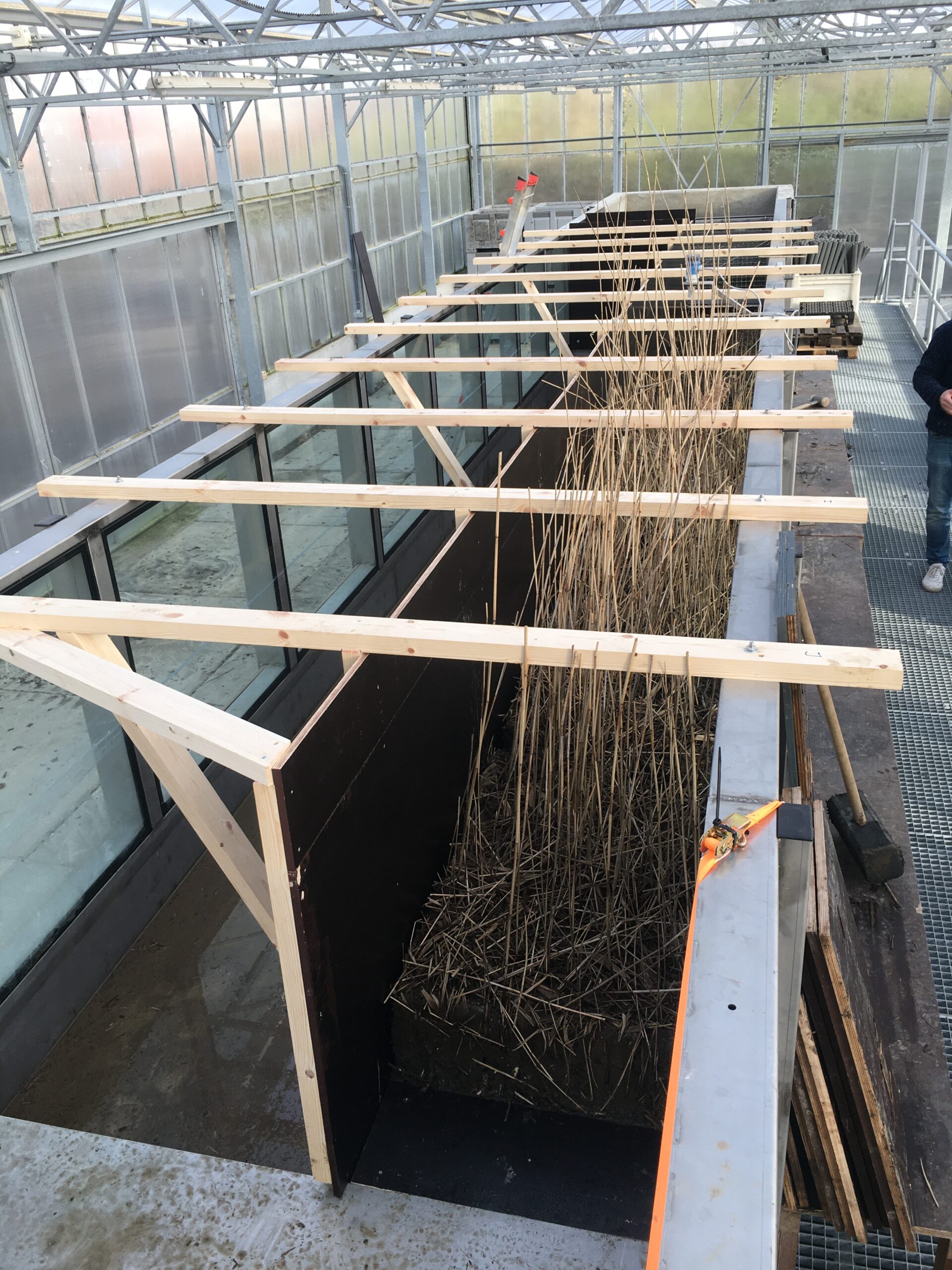
Stability of a tidal marsh under extreme flow conditions: a flume experiment.
This study investigates how well tidal marsh sediments and vegetation withstand extreme flow velocities that may occur during a dike breach. Using Phragmites-dominated marsh monoliths tested in a flume under flows up to 1.75 m s⁻¹, we quantified erosion and vegetation responses over repeated high-energy events. The results showed remarkably limited erosion and rapid vegetation recovery, indicating that well-developed marshes can provide robust natural protection during extreme flooding.
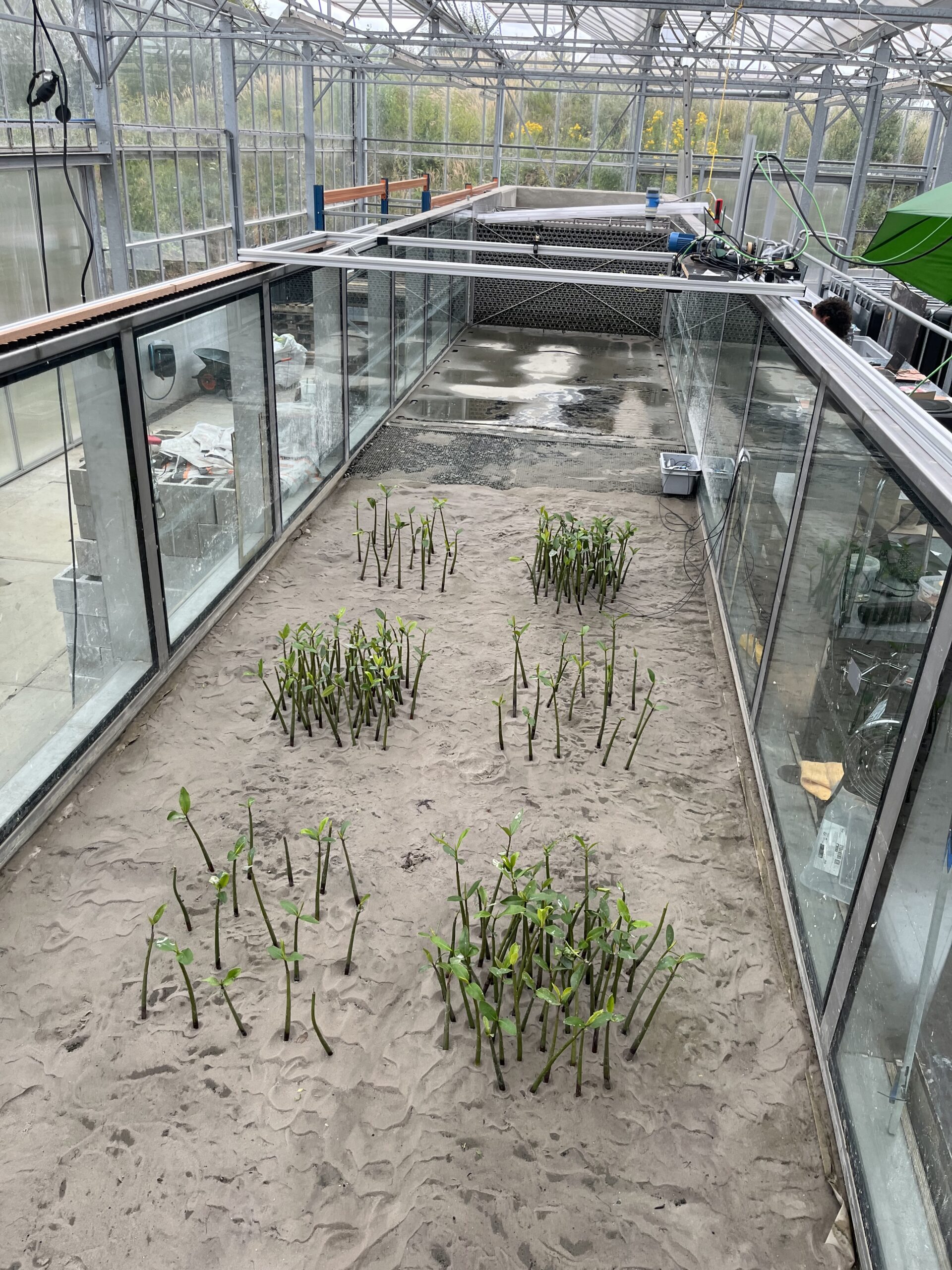
Enhancing mangrove restoration success
This study studies how planting density and spatial configuration influence mangrove seedling persistence under hydrodynamic stress, a key factor in the frequent failure of (re)creation projects. Using flume experiments with mangrove species Rhizophora and a novel LiDAR monitoring technique, we identify planting strategies that enhance stability and improve the success of nature-based coastal restoration.
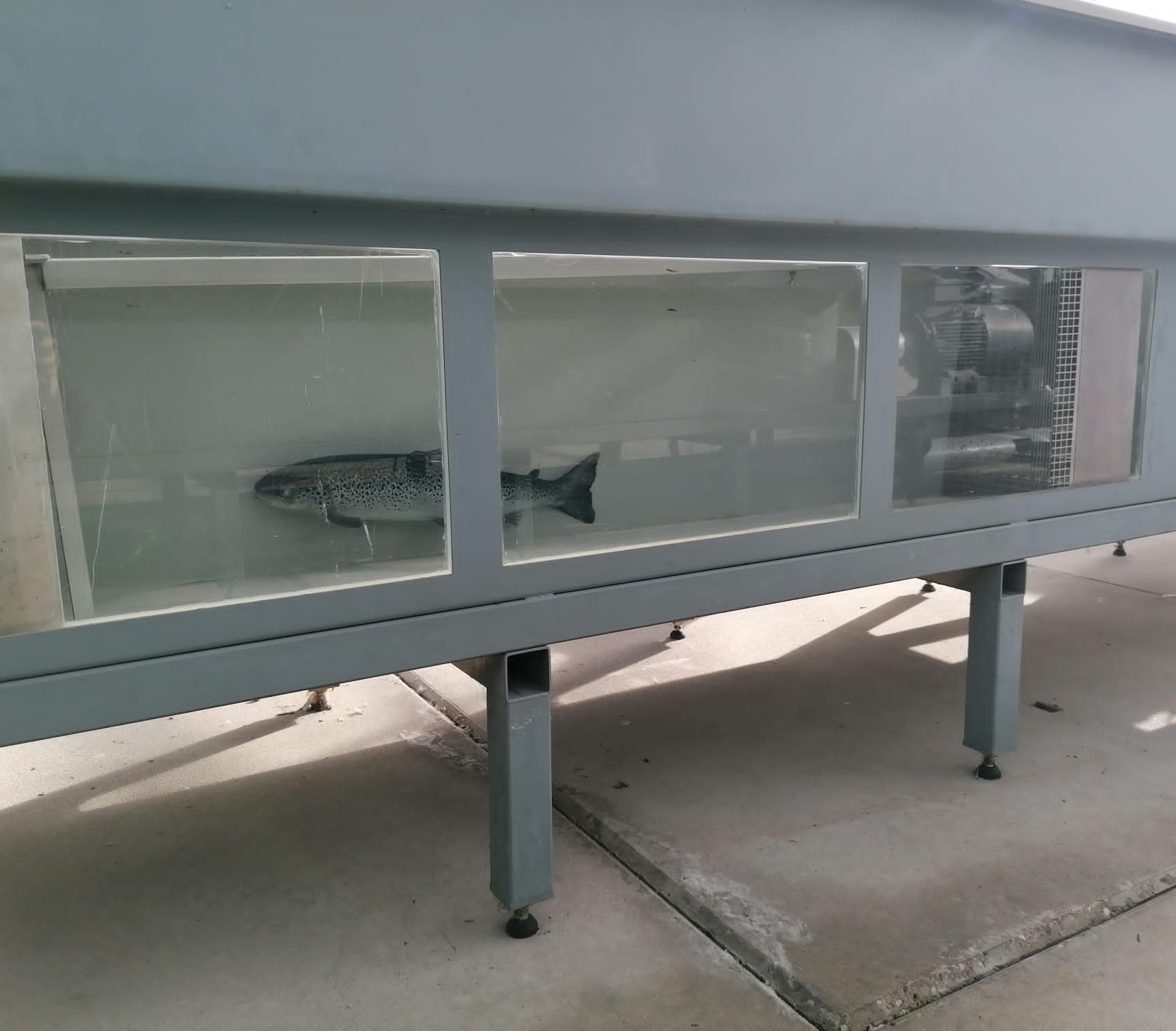
Unravelling the effects of individual coping style and long-term glucocorticoid up-regulation on cardiac remodeling in Atlantic salmon (Salmo salar)
Chronic stress in intensively farmed fish impairs physiological performance and increases unexplained, stress-related mortality—particularly in salmonids—likely due to heart disease linked to prolonged cortisol exposure. This study investigates how individual coping style and long-term cortisol elevation drive cardiac remodeling in Atlantic salmon, and evaluates the resulting impacts on welfare, performance, and potential mitigation strategies.
Selected Publications
Flume:
2026 — Schoutens K., Pelckmans I., Gebruers S. et al. Plant trait trade-offs regulate tidal marsh resistance to combined hydrodynamic and erosion stress. Journal of Applied Ecology, 63(1), e70281.
2022 — Schoutens K. et al. Stability of a tidal marsh under very high flow velocities and implications for nature-based flood defense. Frontiers in Marine Science, 9.
Raceways:
2021 — Flipkens G., Blust R., Town R.M. Environmentally safe olivine guidelines for coastal enhanced silicate weathering. Environmental Science & Technology, 55, 12362–12371.
2020 — Reitsema R. et al. Submerged macrophyte response to increased flow velocity and elevated CO₂. Frontiers in Environmental Science, 11, 527801.
Aquaculture system:
2023 — Opinion A.G.R. et al. Long-term stress induced cortisol downregulation and cardiac remodeling in Atlantic salmon. Journal of Experimental Biology, 226(22), jeb246504.
Experimental ponds:
2024 — Bijns C. et al. Aquatic macroinvertebrate community responses to PFAS pollution. Science of the Total Environment, 917, 170611.
See full publication list
2026 — Bonso M. et al. PFAS in the Scheldt Estuary: insights from target, suspect and non-target screening. Environmental Pollution, 388, 127349.
2026 — Münstermann R. et al. Effects of salinity and inundation on bryophyte coverage and species distribution in a tidal mesocosm experiment. Estuarine, Coastal and Shelf Science, 328, 109630.
2026 — Schoutens K. et al. Plant trait trade-offs regulate tidal marsh resistance to combined hydrodynamic and erosion stress. Journal of Applied Ecology 63.1 (2026): e70281.
2025 — Keirsebelik H. et al. Movement behaviour of Chinese mitten crabs during downstream spawning migration. Movement Ecology, 13(25), 1–16.
2025 — Franquet S. et al. Development and evaluation of a pump sampler for small-bodied fish in challenging environments. River Research and Applications, 41(9), 2052–2058.
2025 — Akter S. et al. Interactive effects of nitrate pollution and heatwaves on aquatic macrophytes. Hydrobiologia, 852(20), 5089–5104.
2025 — Byns C. et al. Active biomonitoring of PFAS in Asian clams and associations with oxidative stress and respiration. Environmental Pollution, 385, 127067.
2024 — Bijns C. et al. Aquatic macroinvertebrate community responses to PFAS pollution: defining threshold body burdens. Science of the Total Environment, 917, 170611.
2024 — Keirsebelik H. et al. Leaf litter processing by invasive Chinese mitten crabs and associated effects on water quality. Biological Invasions.
2023 — Groffen T. et al. Growth hormones in broad bean and radish associated with accumulated concentrations of perfluoroalkyl substances. Toxics, 11(11), 922.
2023 — Opinion A.G.R. et al. Long-term stress induced cortisol downregulation, growth reduction and cardiac remodeling in Atlantic salmon. Journal of Experimental Biology, 226(22), jeb246504.
2022 — Teunen L. et al. Mercury accumulation in freshwater fish species in Flanders and implications for human health risk. Environmental Science and Pollution Research, 29, 7853–7865.
2022 — Teunen L. et al. Relevance of European biota quality standards for ecological water quality: a Flemish case study. Ecotoxicology and Environmental Safety, 231, 113222.
2022 — Schoutens K. et al. Stability of a tidal marsh under very high flow velocities and implications for nature-based flood defense. Frontiers in Marine Science, 9.
2022 — Velimirovic M. et al. What can we learn from studying plastic debris in the Sea Scheldt estuary? Science of the Total Environment, 851, 158226.
2021 — Schoelynck J. et al. Design and testing of a trap removing Chinese mitten crabs from invaded river systems. River Research and Applications, 37, 307–317.
2021 — McKenzie D.J. et al. Aerobic swimming in intensive finfish aquaculture: applications for production, mitigation and selection. Reviews in Aquaculture, 13, 138–155.
2021 — Castaldo G. et al. Temperature effects during a sublethal chronic metal mixture exposure on common carp. Frontiers in Physiology, 12, 284.
2021 — Rodgers E.M. et al. Double whammy: Nitrate pollution heightens susceptibility to both hypoxia and heat in a freshwater salmonid. Science of the Total Environment, 765, 142777.
2021 — Amato E.D. et al. Field application of a novel active-passive sampling technique for simultaneous measurement of contaminants in water. Chemosphere, 279, 130598.
2021 — Flipkens G., Blust R., Town R.M. Deriving nickel and chromium environmentally safe olivine guidelines for coastal enhanced silicate weathering. Environmental Science & Technology, 55, 12362–12371.
2021 — Opinion A.G.R., Cakir R., De Boeck G. Cross-tolerance induced by warm acclimation and nitrate exposure improved aerobic capacity and stress tolerance of common carp. Ecotoxicology and Environmental Safety, 225, 112777.
2021 — Teunen L. et al. PFAS accumulation in aquatic organisms from Belgium with implications for human and ecological health risk. Environmental Sciences Europe, 33, 39.
2021 — Teunen L. et al. Effects of abiotic factors and environmental concentrations on bioaccumulation of contaminants in freshwater fish and mussels. Science of the Total Environment, 799, 149448.
2021 — Van Winckel T. et al. Towards harmonization of water quality management: comparison of drinking water and surface water standards worldwide. Journal of Environmental Management, 298, 113447.
2020 — Opinion A.G.R., De Boeck G., Rodgers E.M. Synergism between elevated temperature and nitrate: impact on aerobic capacity of European grayling. Aquatic Toxicology, 226, 105563.
2020 — Schoelynck J. et al. Experimental evidence for the decline of submerged vegetation by invasive Chinese mitten crab. Biological Invasions, 22, 627–641.
2020 — Reitsema R. et al. Response of submerged macrophytes to increased flow velocity and elevated CO₂. Frontiers in Environmental Science, 11, 527801.
2020 — Reitsema R.E. et al. Climate change effects on submerged macrophytes. Aquatic Ecology, 54, 775–793.
2019 — Wolters J.W. et al. Macrophyte-specific effects on epiphyton and macroinvertebrates. Freshwater Biology, 64, 1131–1142.
2019 — Shrivastava J. et al. Exercise improves growth and physiological performance in common carp. Comparative Biochemistry and Physiology Part A, 226, 38–48.
2019 — Bashnin T. et al. Pesticide accumulation in zebra mussels and macroinvertebrate communities. Environmental Pollution, 252, 591–598.
2019 — Rodgers E.M., De Boeck G. Nitrite-induced reductions in heat tolerance in freshwater teleost. Journal of Experimental Biology, 222, jeb212035.
2019 — Pillet M. et al. Limited oxidative stress in carp exposed to a metal mixture. Comparative Biochemistry and Physiology Part C, 218, 70–80.
2019 — Amato E.D. et al. Accumulation of contaminants on an active-passive sampling device. Chemosphere, 236, 124400.
2018 — Van Ginneken M., Blust R., Bervoets L. Combined effects of metal mixtures and predator stress. Aquatic Toxicology, 200, 148–157.
2017 — Van Ginneken M., Blust R., Bervoets L. Toxicity of cadmium, copper, and lead to Asellus aquaticus. Environmental Toxicology and Chemistry, 36(10), 2849–2854.
Contact
Prof. Dr. Gudrun De Boeck

Prof. Dr. Jonas Schoelynck

Lotte Oosterlee MSc
Location
Campus Drie Eiken – Building C Universiteitsplein 1 2610 Wilrijk, Belgium